Home / Membership / The Garden Planner
A Morning Post members' tool · planting calendar

What to plant now: a vegetable planting calendar for your postcode.

Tell it where you garden and it does the calendar arithmetic for you: which vegetables, herbs and fruit go in now in your climate zone, what's ready to harvest, and the jobs worth doing this week. Built on Australian seasons — not a Northern-hemisphere app's idea of spring.

All five Australian climate zonesVegetables, herbs and fruitPrint it and keep it
See what membership includes →$79 a year · covers the household · 60-day money-back guarantee
The Garden Planner's This Week screen for postcode 3018, cool zone: a frost warning and what's good to sow or plant in September
See it working

This week, the calendar, your patch — the real screens.

Captured from the tool set to a cool-zone Melbourne postcode in early September.

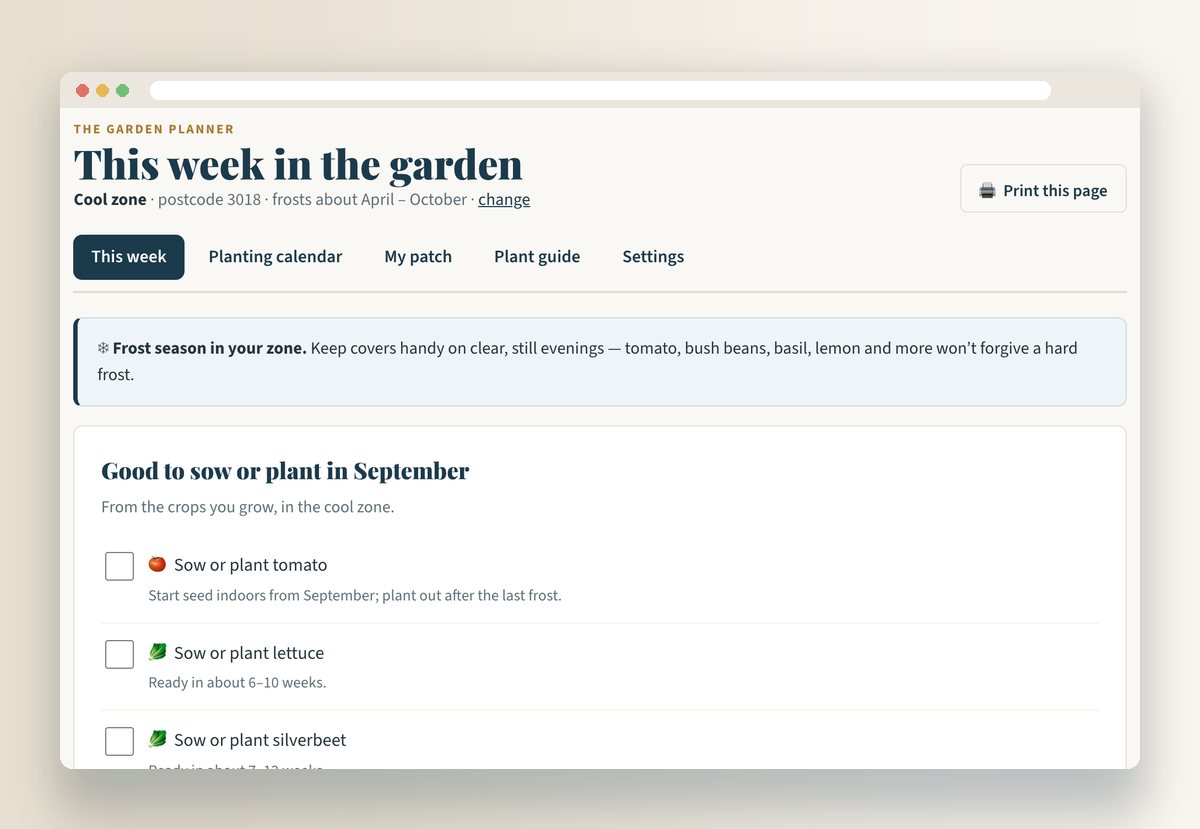
This week in the garden: frost season warning and the September sowing list for the cool zone
Feature 1

This week: what to sow, plant and pick

One screen for the week — a frost note if your zone is in frost season, the crops that are good to sow or plant now from the ones you grow, what else is in season if you're tempted, this week's jobs, and what's worth checking for harvest.

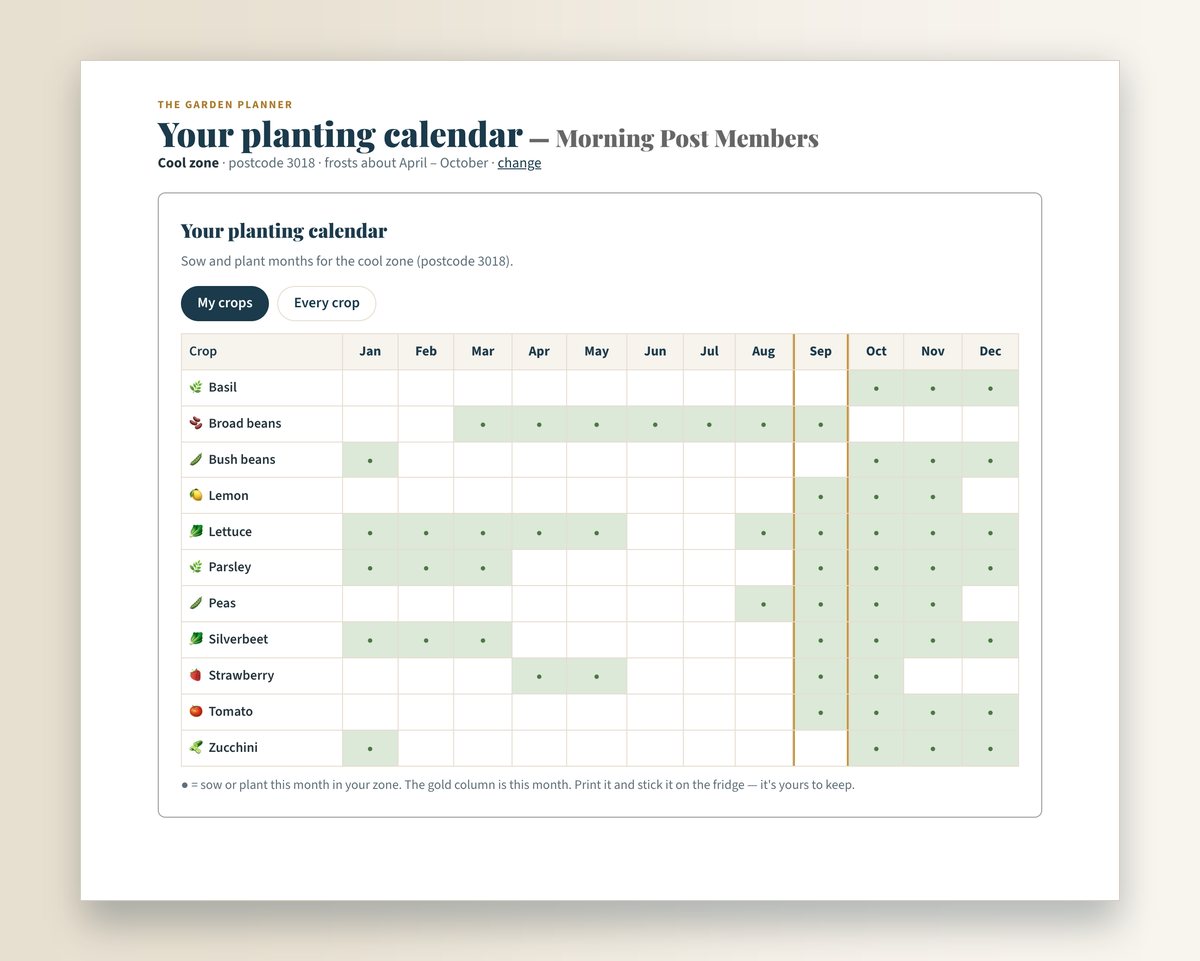
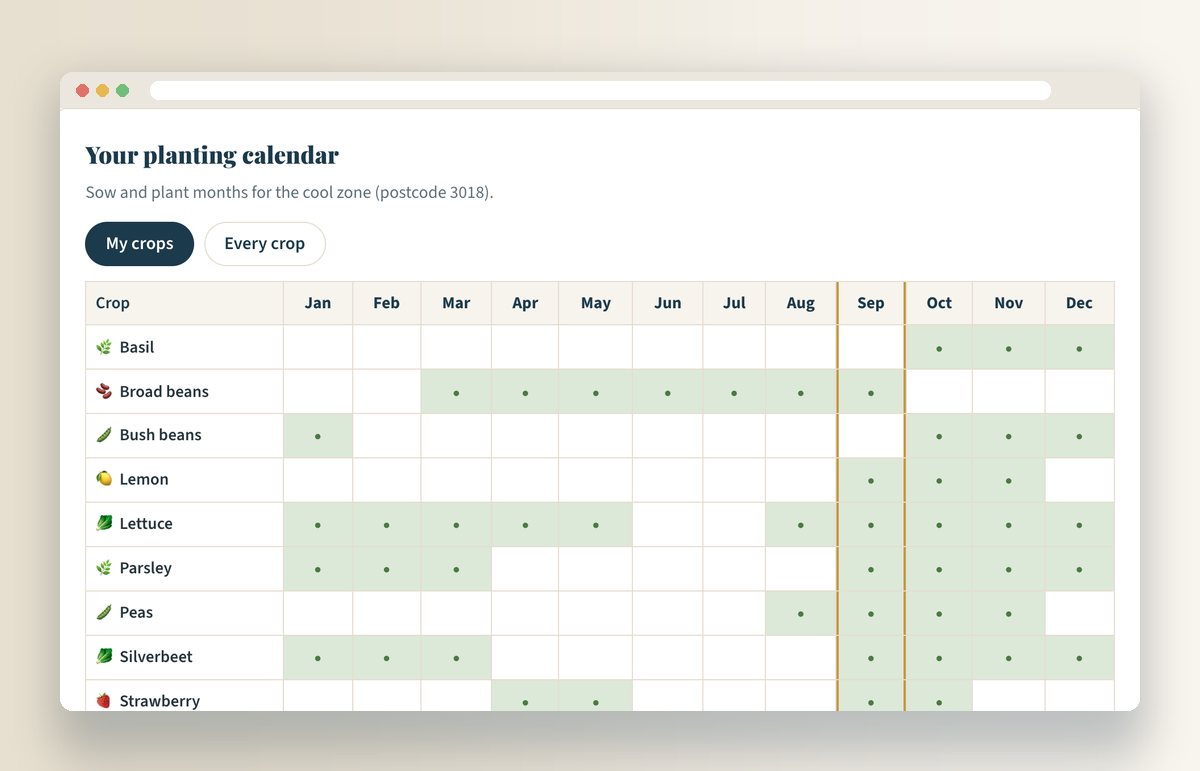
The planting calendar: crops down the side, months across the top, dots for the sowing months, September highlighted
Feature 2

Your 12-month planting calendar

Every crop you grow across every month, with this month marked in gold. Switch to 'every crop' to see the whole 65 for your zone. An empty row means not recommended where you are — the planner says so rather than guessing.

The printed planting calendar: a single landscape page
Print and keep

Print it for the shed wall

The calendar prints on a single landscape page, headed with your zone and postcode. Nothing here is held hostage to the app — what you've planned is yours on paper.

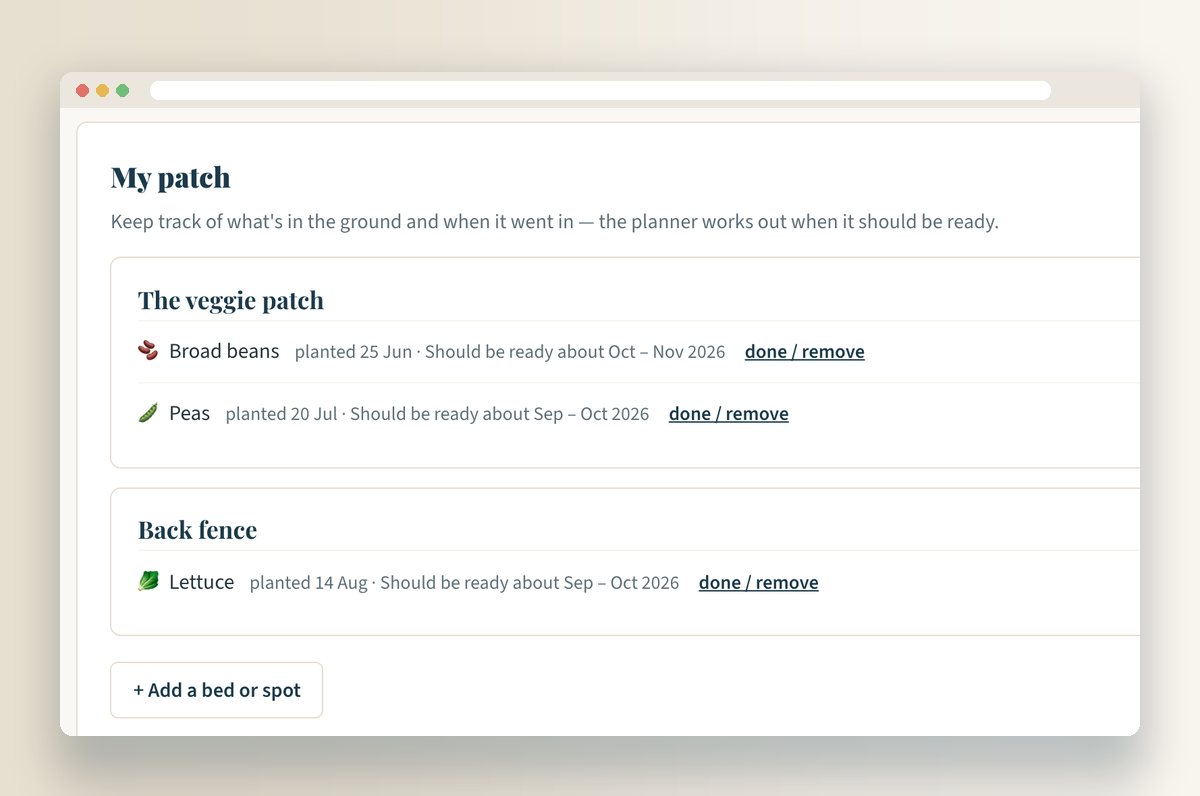
My patch: broad beans and peas in the veggie patch, lettuce along the back fence, each with a should-be-ready date
Feature 4

My patch: what's in, and when it's ready

Log what you've put in and where — a bed, a pot, the back fence — and the planner works out when each planting should be ready to pick, then nudges you on the This Week screen as harvest nears.

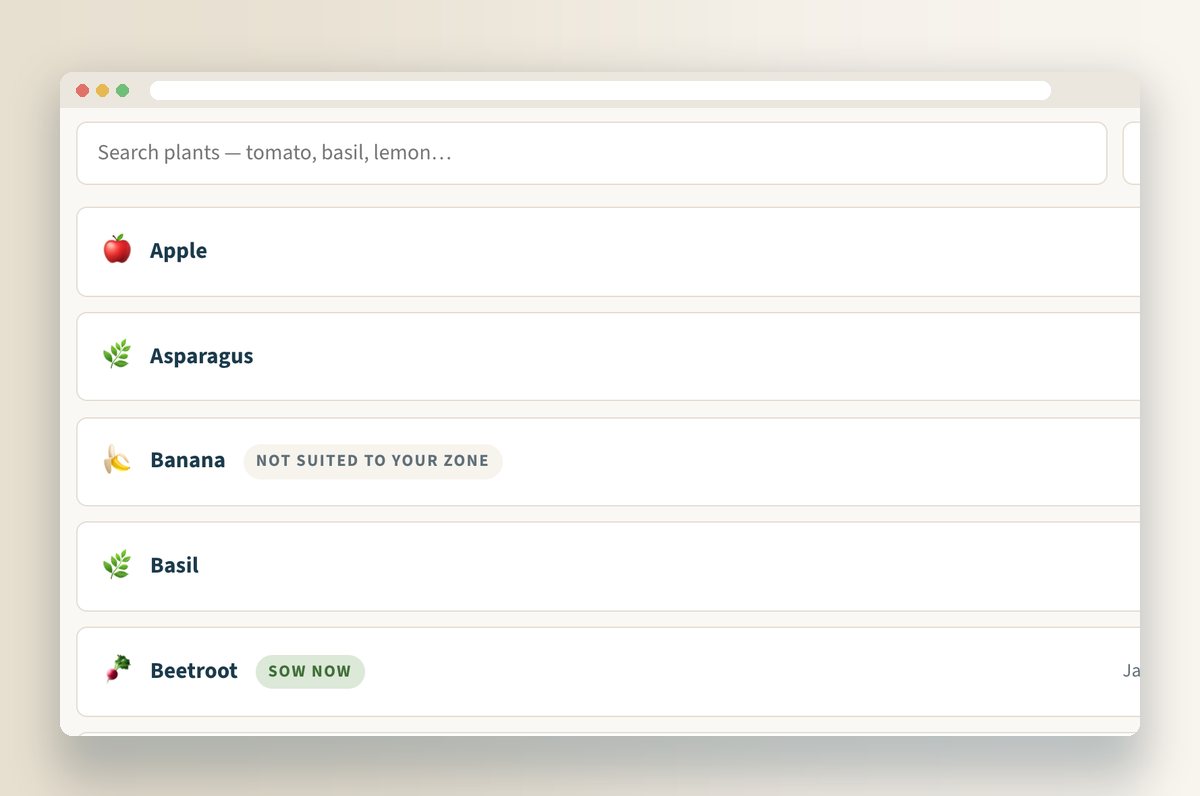
The plant guide: apple, asparagus, basil, beetroot and blueberry with their sowing months and Sow Now badges
Feature 5

65 crops, with varieties you can buy here

Tomatoes to garlic, silverbeet to passionfruit — each with its sowing months for your zone, named Australian varieties, spacing, sun and the honest sow-to-harvest wait. A crop that won't suit your zone is labelled, not hidden.

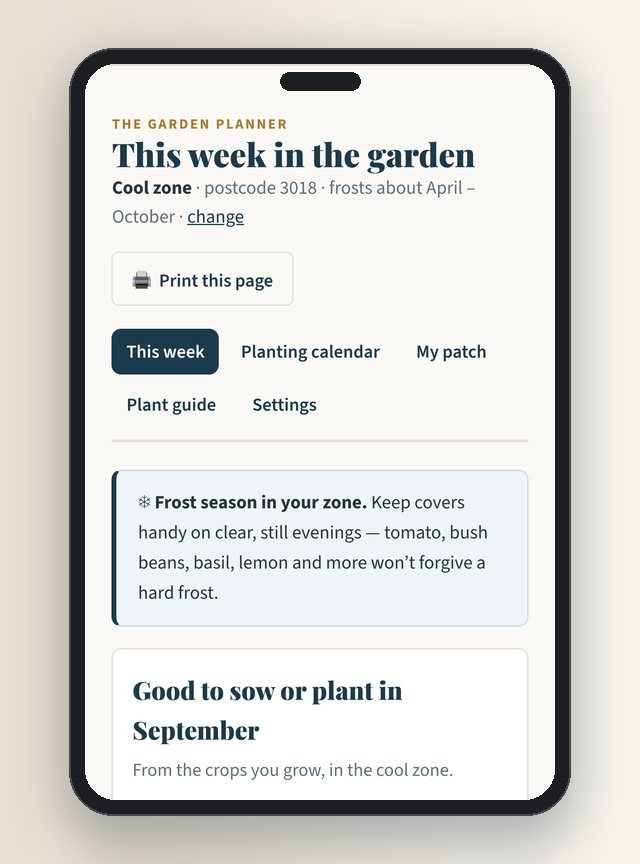
The This Week screen on a phone
On the phone

In the garden, on the phone

Check the week's list with muddy hands. One column, large type, tick things off as you go.

How it works

Three minutes to set up. Then just check in each week.

1

Type your postcode

That gives it your climate zone and your usual frost window. Both can be adjusted — and if your patch never gets frost, you can say so and it stops warning you.

2

See this week

Good to sow or plant now, what's also in season if you're tempted, the jobs for the week, and what's worth checking for harvest. One screen, no digging through menus.

3

Log your patch

Note what you've put in and where. The planner nudges you as harvest nears, and the 12-month planting calendar prints on a single page for the shed wall.

Why it's different

Built on Australian seasons, written for a kitchen-table gardener.

Five zones, not one calendar

Cool, temperate, subtropical, tropical and arid — each anchored to its harshest member, so a 'sow now' in Canberra is frost-safe and a 'sow now' in Brisbane knows winter is the growing season. Melbourne, Sydney, Perth and Adelaide each resolve to the right one from the postcode.

A planting guide, not a drawing program

No drag-and-drop bed designer to wrestle with. It's lists you can read at a glance — which is also why you won't have to relearn it every spring.

65 crops, with varieties you can actually buy

Tomatoes to garlic, silverbeet to passionfruit, each with named Australian varieties, spacing, sun and the honest sow-to-harvest wait.

Print it, keep it

The planting calendar and your patch both print cleanly. Nothing is held hostage to a subscription — what you've planned is yours on paper.

Where the dates come from

Every sowing window was checked before it went near a member.

A planting calendar is only as good as its dates. Ours was cross-checked, zone by zone, against the seed-house and state-agriculture planting guides.

5 zones × 12 months

Each crop's window is set separately for every climate zone — an empty window means 'not recommended where you are', and the planner says so rather than guessing.

Checked, then fixed

Before launch the whole calendar was audited against Gardenate, Yates and the state agriculture departments' guides. The wrong-season entries that turned up were corrected, not shipped.

Curated, never invented

The plant guide is written and checked in advance and never generated on the fly — so the advice is the same, and the same quality, every time you open it.

How to use it

Included with Morning Post membership.

The Garden Planner is one of the members' tools — alongside all 18 classes, both workbooks, the four mysteries and the other tools. Garden-planner apps charge $35 a year or more for this alone; membership is $79 a year for all of it — about $550 of value, for the whole household.

Morning Post Members
$79 / year
  • The Garden Planner — your postcode, week by week
  • All 18 classes, both workbooks, four mysteries
  • Brain training, bill check, family tree, phrasebook
  • Covers your household
  • 60-day money-back guarantee
See what membership includes →

Already a member? Go straight to the tool →

Questions

The details.

Which parts of Australia does it cover?

All of it. Every postcode resolves to one of five climate zones — cool, temperate, subtropical, tropical or arid — and you can override the zone with one tap if you know your patch behaves differently (a hillside frost pocket, a coastal microclimate).

What can I plant now in Melbourne, Sydney or Brisbane?

That's exactly the question the This Week screen answers, for your postcode rather than your city — a Melbourne postcode lands in the cool or temperate zone, Sydney and Perth in temperate, Brisbane in subtropical, and the sowing list changes accordingly. In early September that means tomato seed indoors and lettuce out in Melbourne, while Brisbane is coming off its winter growing season.

Does it cover flowers and ornamentals?

Not yet — it's vegetables, herbs and fruit first, because that's what readers asked for. If members want flowers next, they can say so in the members' poll.

What if the frost dates are wrong for my garden?

Change them. The frost window is a starting estimate for your zone; you can move it, or tell the planner your patch never gets frost at all.

Is my garden saved?

Yes — your patch and settings are saved to your membership, so they follow you between the phone, the iPad and the computer. You can print or download your plan any time.

Is there a weekly email?

Not yet. The 'This week' screen is the weekly check-in for now; a short weekly garden email is on the list if members ask for it.
More members' tools

Also included in membership.