Upload your latest gas or electricity bill and the Energy Bill Check compares it against every current plan for your postcode — the government's own plan data, not a comparison site's shortlist. If a cheaper plan exists, it tells you. If you're already on a good deal, it tells you that too.

These are real screens from the tool, run on a real 55-day gas bill from a Melbourne postcode.

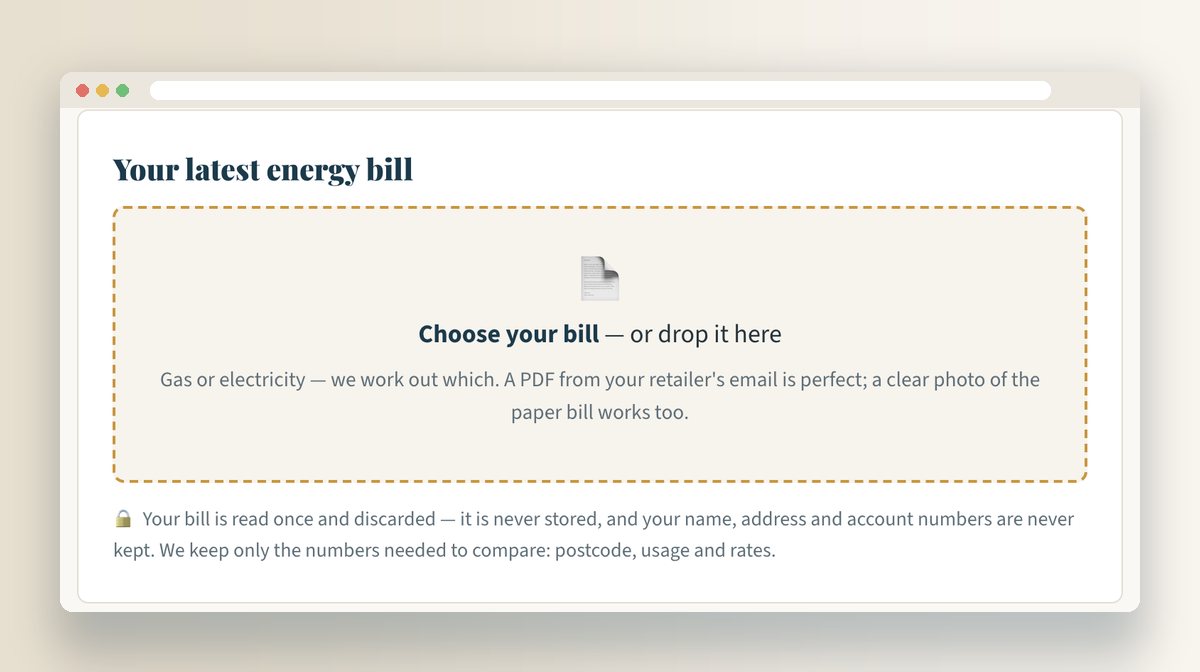
Upload the PDF from your retailer's email, or a clear photo of the paper bill. The tool reads the usage, the billing period, the rates and any solar exports, then shows you what it found so you can confirm the numbers before anything runs. Gas, electricity, or a combined bill — it works out which.

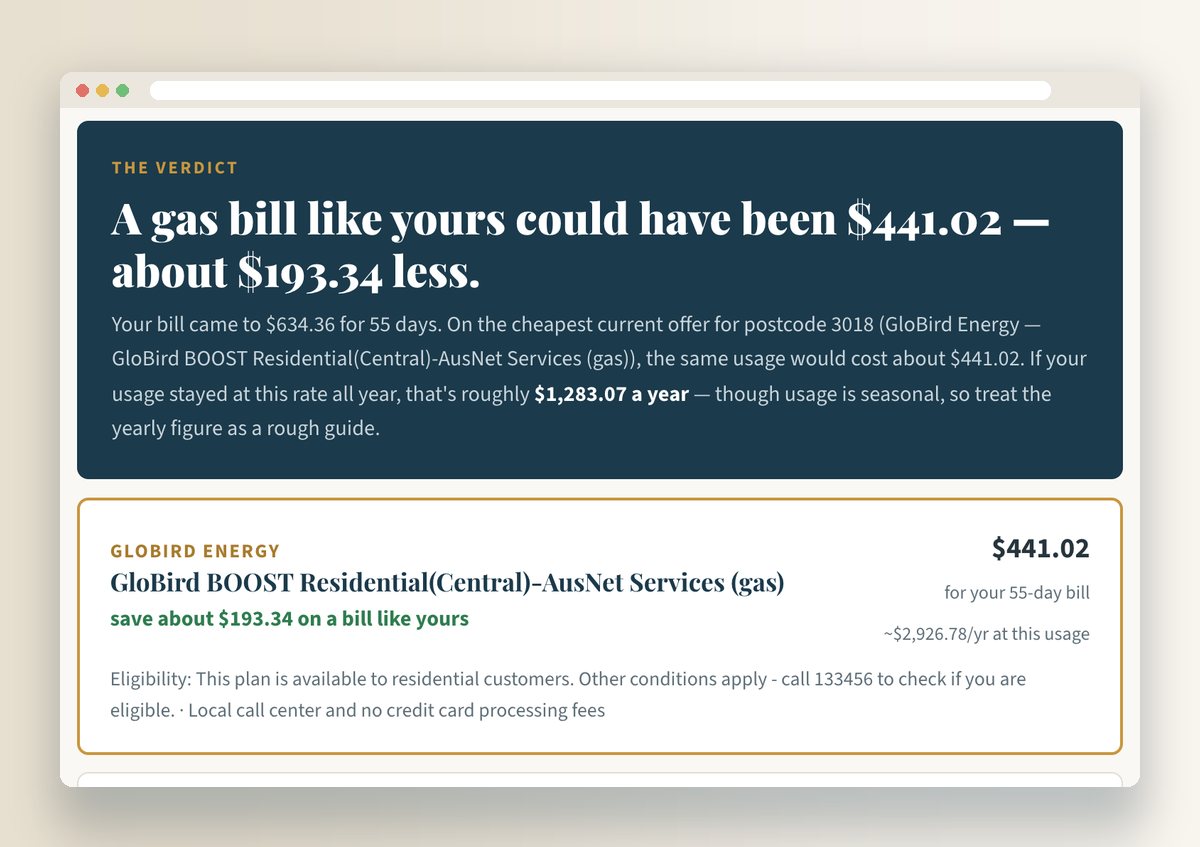
Not a star rating or a 'you could save up to' — a sentence. What this exact bill would have cost on the cheapest current plan for your postcode, how much less that is, and a rough yearly figure with the honest caveat that usage is seasonal.

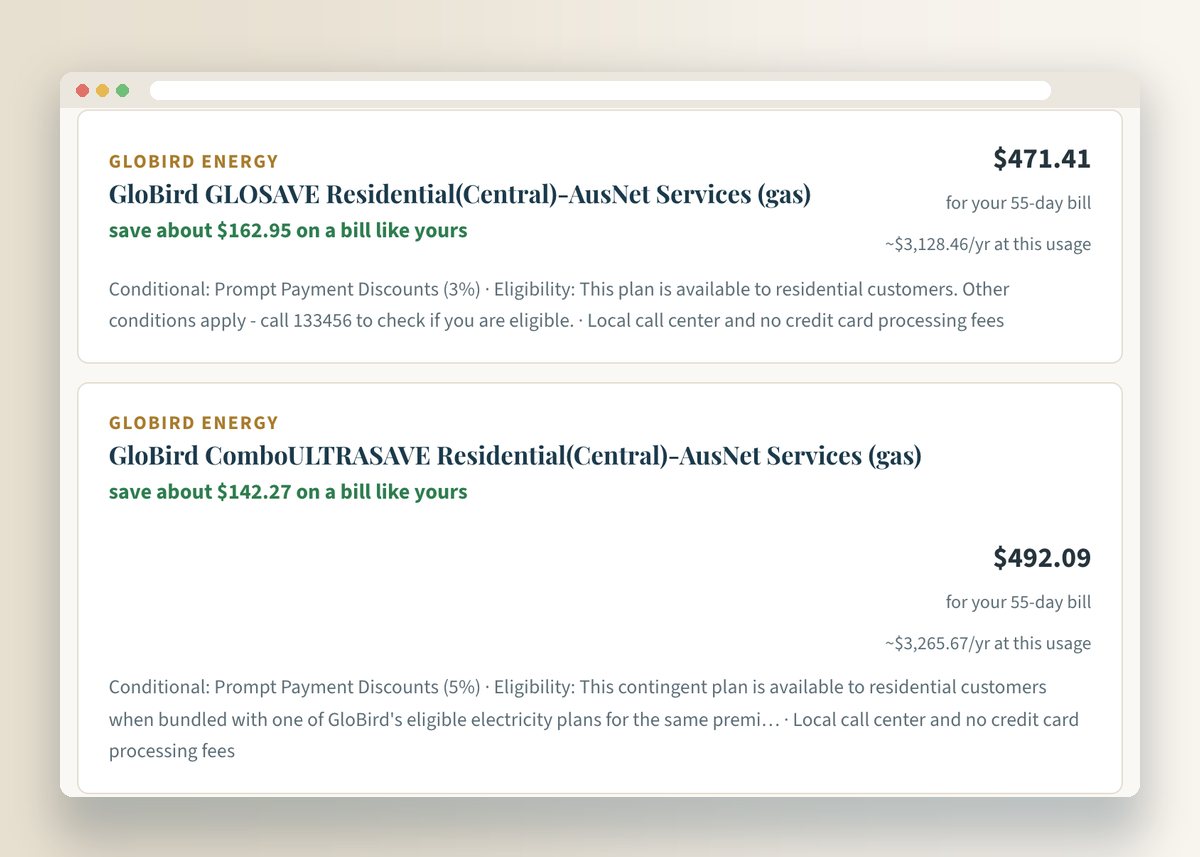
Every current offer for your postcode, priced against your actual usage and sorted cheapest first — with the conditional discounts and eligibility fine print shown, not hidden. The plan you're on is in the list too, so you can see exactly where it sits.

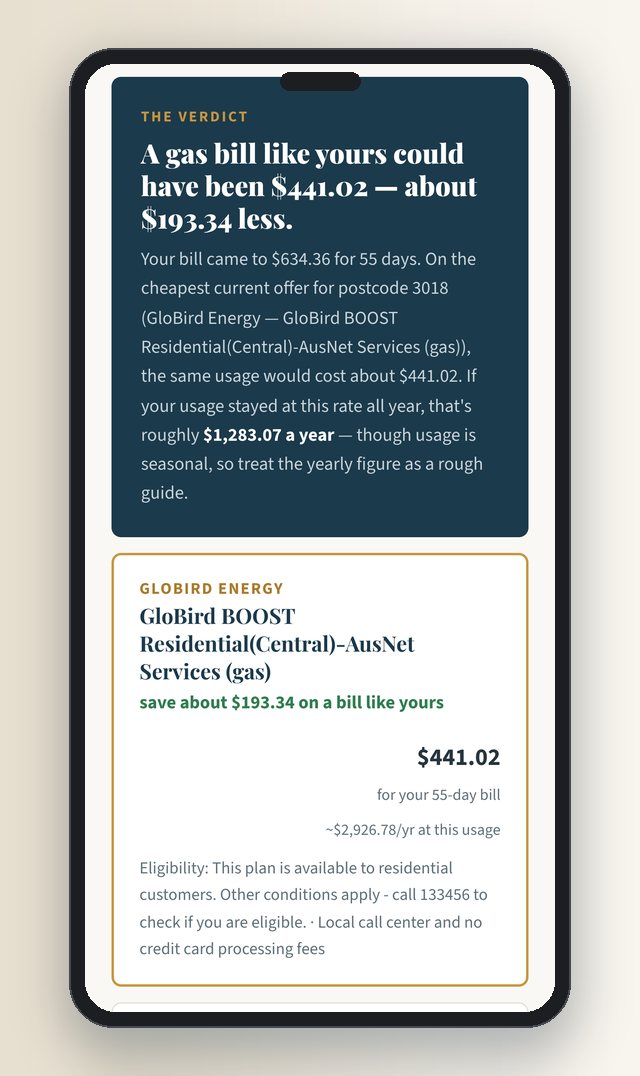
Photograph the paper bill on the kitchen bench and read the verdict on the same screen. Large type, one column, nothing fiddly.
The PDF from your retailer's email, or a clear photo of the paper bill. A combined gas-and-electricity bill gets both fuels checked in one go.
We read the bill and show you what we found — usage, billing period, solar exports — so you can confirm it matches before anything runs.
Your actual usage is priced against every current offer for your postcode, on the spot. The verdict is in plain dollars: what this bill would have cost on each plan.
The comparison runs on the Consumer Data Right plan data retailers are required to publish — thousands of plans across NSW, Victoria, Queensland, SA, the ACT and Tasmania — the same data behind Energy Made Easy and Victorian Energy Compare.
We take no payment from any retailer and no fee for placement. The ranking is purely the arithmetic — which is exactly why we can tell you when the honest answer is "stay put".
The bill is read once and discarded — never stored. Your name, address and account numbers are never kept; we keep only the numbers needed to compare.
Solar feed-in rates are credited at the daytime rate solar actually earns — not the headline evening rate some plans advertise. Estimates are labelled as estimates, and we point you to Energy Made Easy or Victorian Energy Compare to confirm before switching.
Before this tool went near a member, we ran our own household bills through it — and checked the answers against the regulators' own numbers.
On our own gas bill, the tool found a $193 saving on a single bill — and independently priced the very plan the bill's government-mandated "better offer" notice named.
For electricity, the tool's pricing of the regulated default offer matches the figure published by Victoria's Essential Services Commission exactly — same arithmetic, same answer.
Sometimes the cheapest plan is the one you're on. When that's the verdict, the tool says so plainly — there's no commission nudging it to tell you otherwise.
Energy Bill Check is one of the members' tools — alongside all 18 classes, both workbooks, the four mysteries and the other tools. Bill-checking services charge $49 a year or more for this alone; membership is $79 a year for all of it — about $550 of value, for the whole household.
Already a member? Go straight to the tool →
NSW, Victoria, Queensland, South Australia, the ACT and Tasmania — everywhere the national Consumer Data Right plan database reaches. WA and the NT sit outside that scheme (and WA household electricity is a single regulated provider), so the tool tells readers there so honestly rather than pretending to compare.
It starts from your actual bill rather than an estimate of your usage, and it uses the same government plan data Energy Made Easy does — every plan, not a panel of partners. Commercial comparison sites are paid by the retailers they list; we're paid by the membership fee, so there's nothing steering the answer.
Gas bills, electricity bills, and combined bills (both fuels checked in one pass). It handles flat-rate and time-of-use pricing, controlled load (off-peak hot water), and solar feed-in. Bills with demand charges are compared against non-demand plans, and it says so. It works from the PDF in your retailer's email or a clear photo of the paper bill.
Yes — the membership fee is how this is paid for, so there's no need to take a cent from retailers. We have no referral deals and earn nothing when you switch; the tool just tells you what the numbers say, and switching is something you do directly with the retailer.
It's read once, by a machine, and discarded — the file itself is deleted within seconds and is never stored. Your name, address, account and meter numbers are never kept. The only things retained for the comparison are the numbers on the bill: postcode, usage, dates and rates.
They're estimates, computed from each plan's published rates and guaranteed discounts, and labelled as such — conditional discounts, concessions and one-off fees are shown but not assumed. We validate the arithmetic against the regulators' own published figures, and the results page links you to Energy Made Easy or Victorian Energy Compare to confirm any plan before you switch.