Build your family one person at a time — parents, partners, children, step and adopted relations all handled properly — and write down the memories beside them before they wander off. Private to your family, printable for the wall, and yours to download in a format any family-history program can open.

Real screens from the tool, built around an invented Bendigo family.

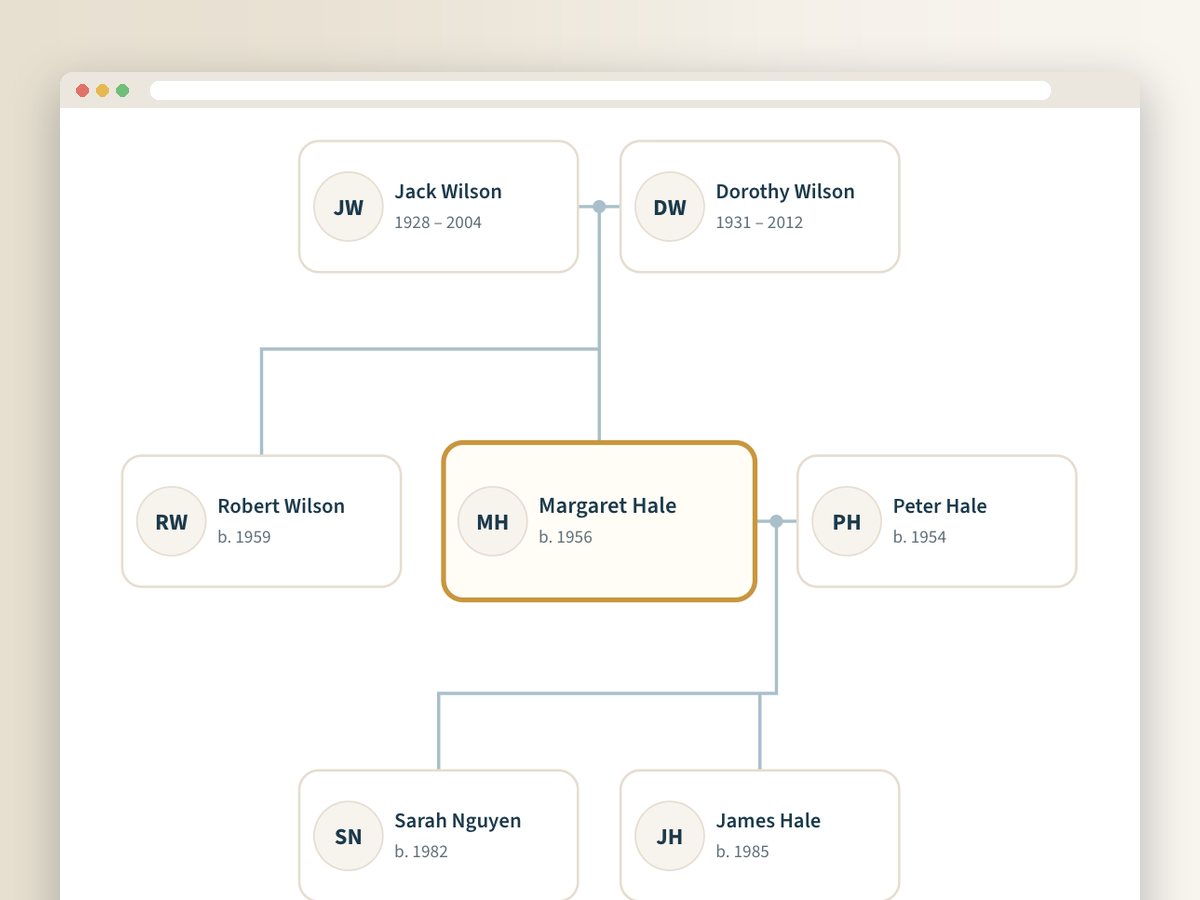
Start with yourself and add parents, partners, siblings and children. Tap anyone to move to them and see their own parents, partners and children — the view stays readable however big the family gets. Second marriages, step and adopted children, single parents and siblings whose parents you haven't added yet all sit where they belong.

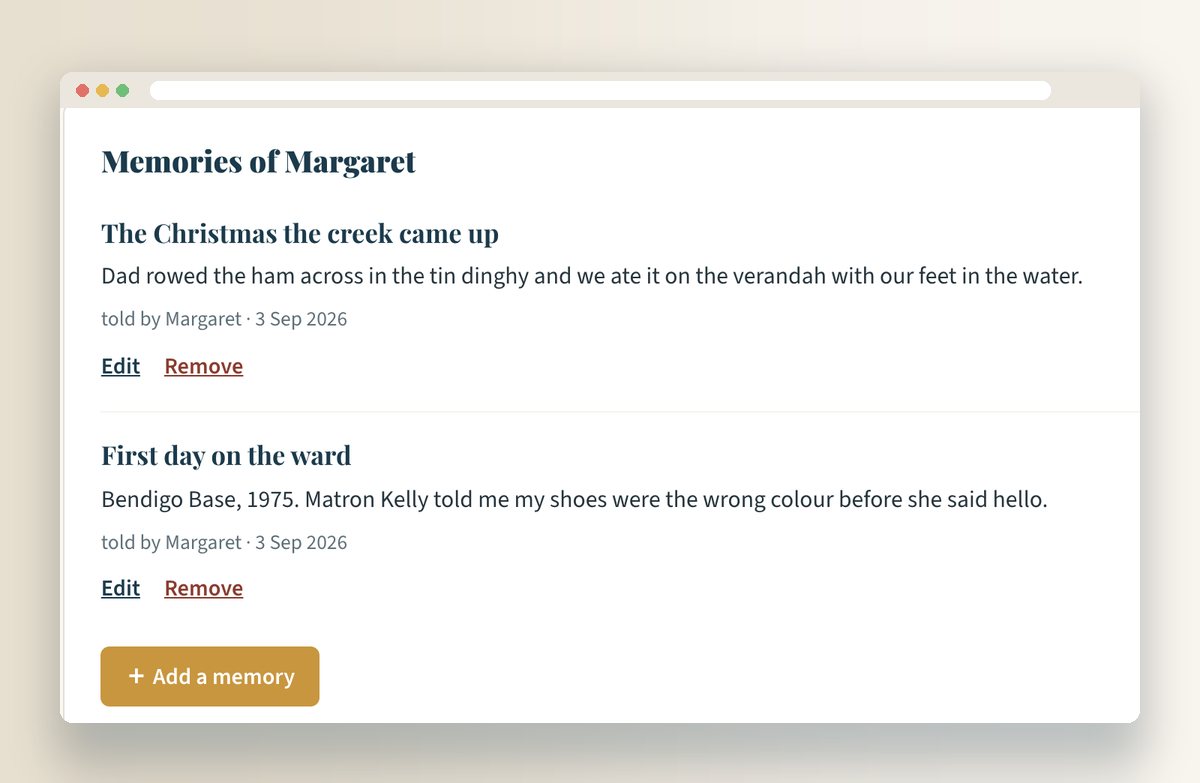
Each person carries their own stories — the ones you'd otherwise tell once at a funeral. Gentle prompts help get them started (what did they do on a Sunday, what did their kitchen smell like), and each person can hold as many as you like.
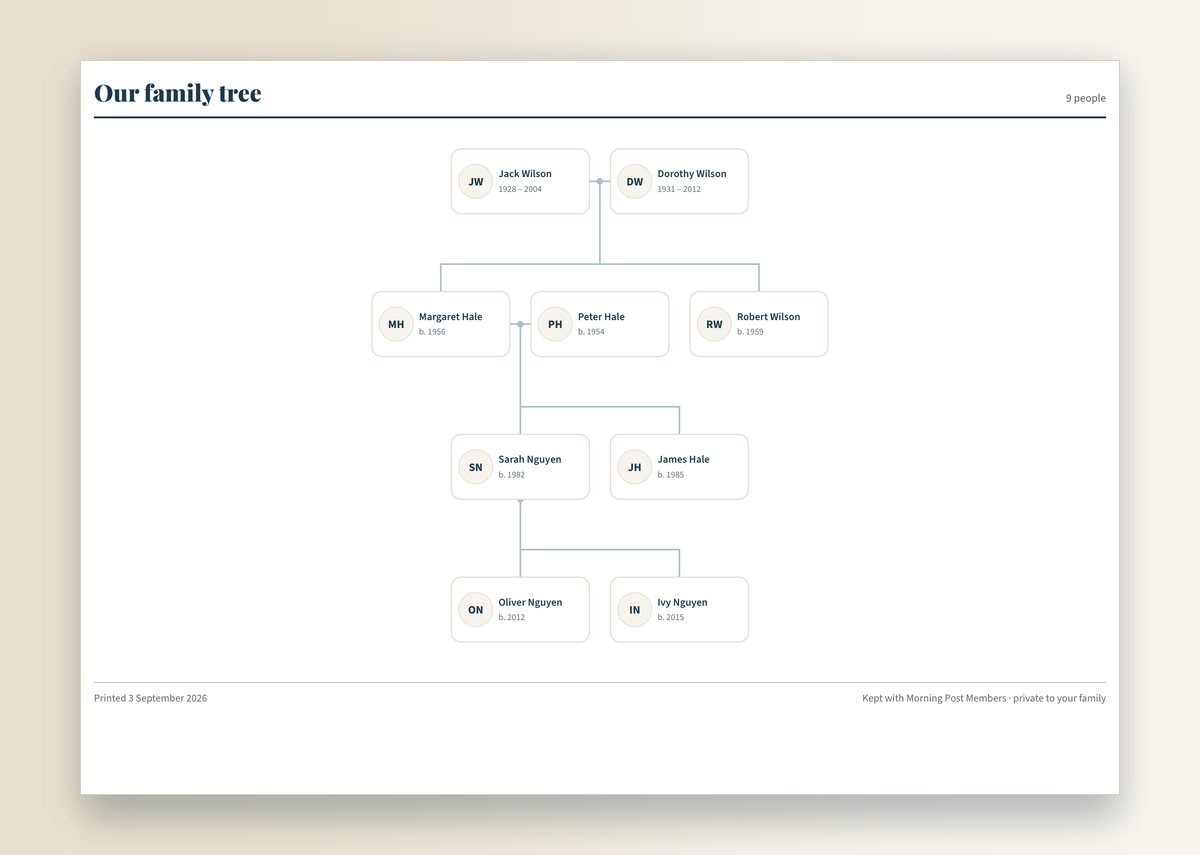
A generational chart that fits itself to a single landscape sheet — parents above, children below, partners side by side — headed with your family and dated. Cmd+P or Ctrl+P and it's on the wall.

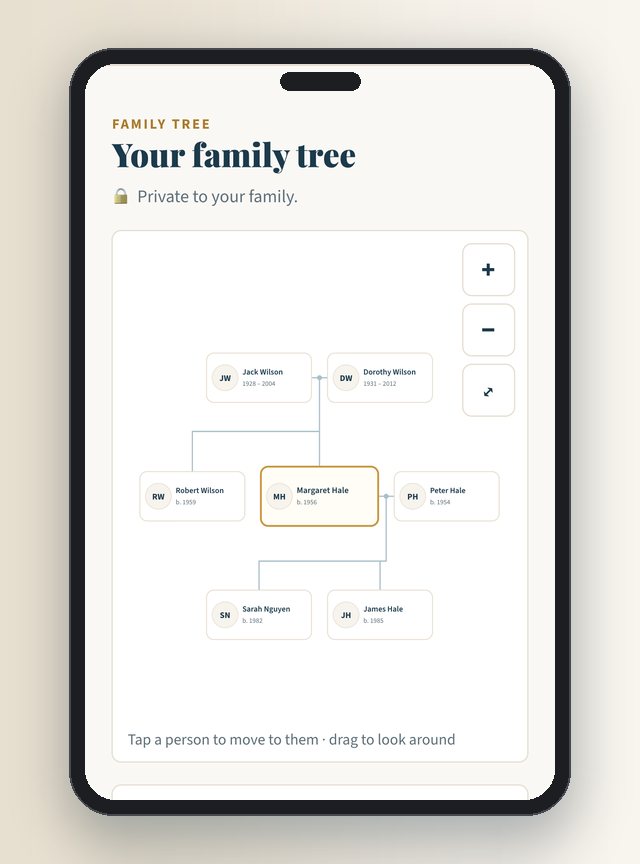
It works on the phone as well as the computer — the tree pans and zooms under a finger, and adding a person is a short form.
Yourself first, then parents, partners, siblings and children. Dates however you know them — '1952', 'about 1920', 'summer 1962' are all fine. Nothing insists on a full date you don't have.
A portrait for each person, and a memory or two beside them. Gentle prompts help — what did they do on a Sunday, what did their kitchen smell like — so the stories come out, not just the facts.
The whole tree on one landscape page for the wall, or 'The Story of' one person — their portrait, dates and memories — as a page worth framing. And the lot as a file, whenever you like.
Second marriages, step-parents, adopted and foster children, single parents, siblings whose parents you haven't got to yet — nothing is forced into one-mother-one-father boxes.
A date picker that demands day, month and year is how most family trees die on page one. Here 'circa 1920' is a perfectly good answer, and the tree sorts itself out.
Each person carries their own stories — the ones you'd otherwise tell once at a funeral. That's the reason we built it.
Private by default: no public trees, no hints from strangers' trees, no ads. Export to GEDCOM (the format Ancestry, MyHeritage and Family Echo all open) or a plain backup file, any time.
The commonest complaint about family-tree software is that your years of work are held to a subscription. Everything here can leave with you.
A generational chart that fits itself to a single landscape sheet — parents above, children below, partners side by side. Cmd+P or Ctrl+P and it's done.
Any person as an A4 page: portrait, dates, places, and every memory you've written for them. A birthday present, or the page at the front of the album.
Export the tree as GEDCOM — tested end-to-end into another family-tree program with every person and relationship intact — plus a plain backup you can keep on your own computer.
The Family Tree is one of the members' tools — alongside all 18 classes, both workbooks, the four mysteries and the other tools. Family-tree software charges $59 a year or more; membership is $79 a year for all of it — about $550 of value, for the whole household.
Already a member? Go straight to the tool →
Yes. Your tree is visible only to whoever holds your members' link — that's you and the person you live with. There are no public trees, we don't match your relatives against other people's trees, and we never share it.
It's included in Morning Post membership — $79 a year for the household, alongside the classes, workbooks, mysteries and the other members' tools — rather than free-with-ads or free-until-you-want-to-print. Everything you build can be exported and kept, so nothing is held to the subscription.
Your household shares your members' link, so anyone you share that with can work on it. A view-only link for the wider family — cousins, grandchildren — is the most-asked-for next step, and members are voting on it now.
Not yet. You can export from here to GEDCOM and open it anywhere; bringing an existing GEDCOM file in is on the list and members can vote for it.
One portrait per person, cropped to a neat square — enough to put faces to the names on the printed chart. Full photo albums are a possible next step, again by members' vote.
Short stories attached to a person: how your grandmother took her tea, the job your father did before the war, the thing your uncle always said. Prompts help you get started, and each person can hold as many as you like.