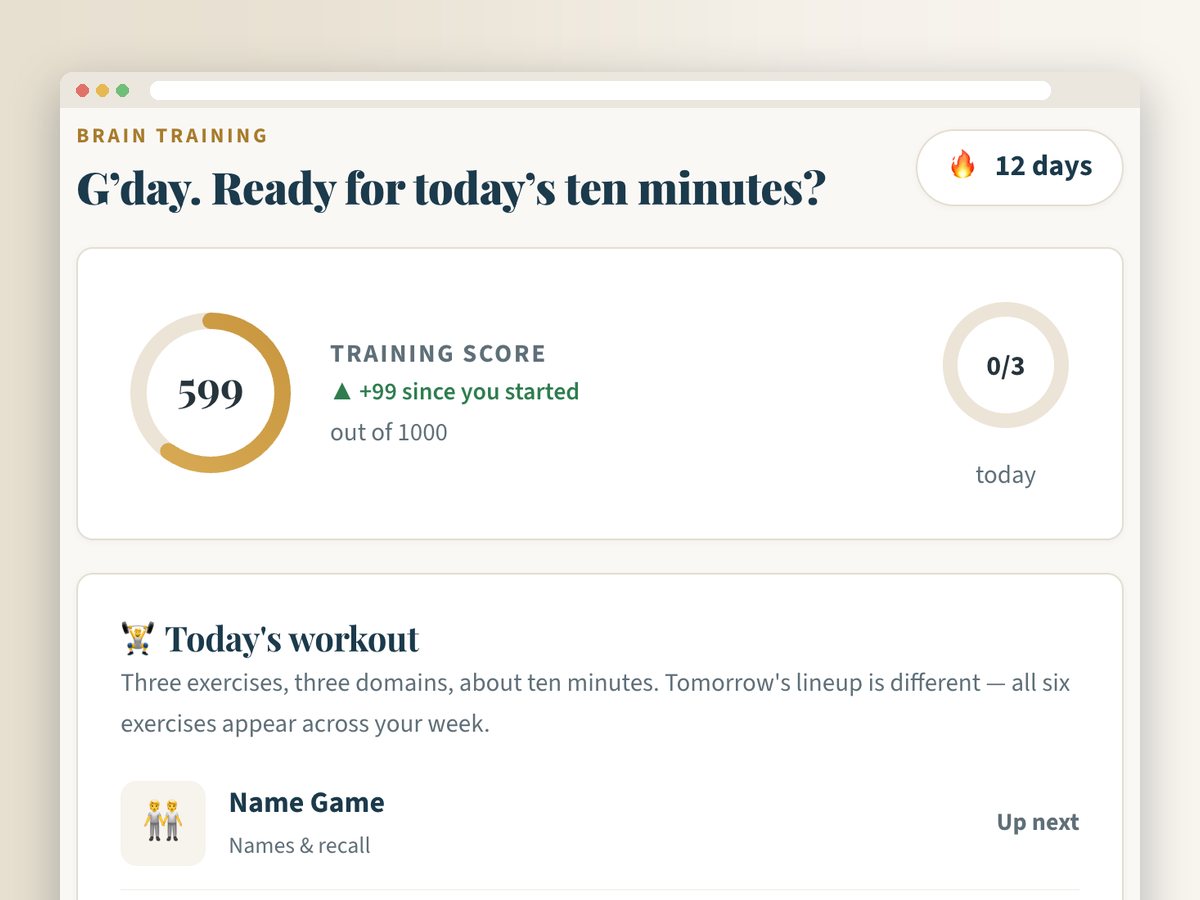
Six short exercises — speed, memory, attention and putting names to faces — with a fresh workout every day, streaks and personal bests. It sits alongside the free daily puzzles you already do; this is the structured ten minutes.

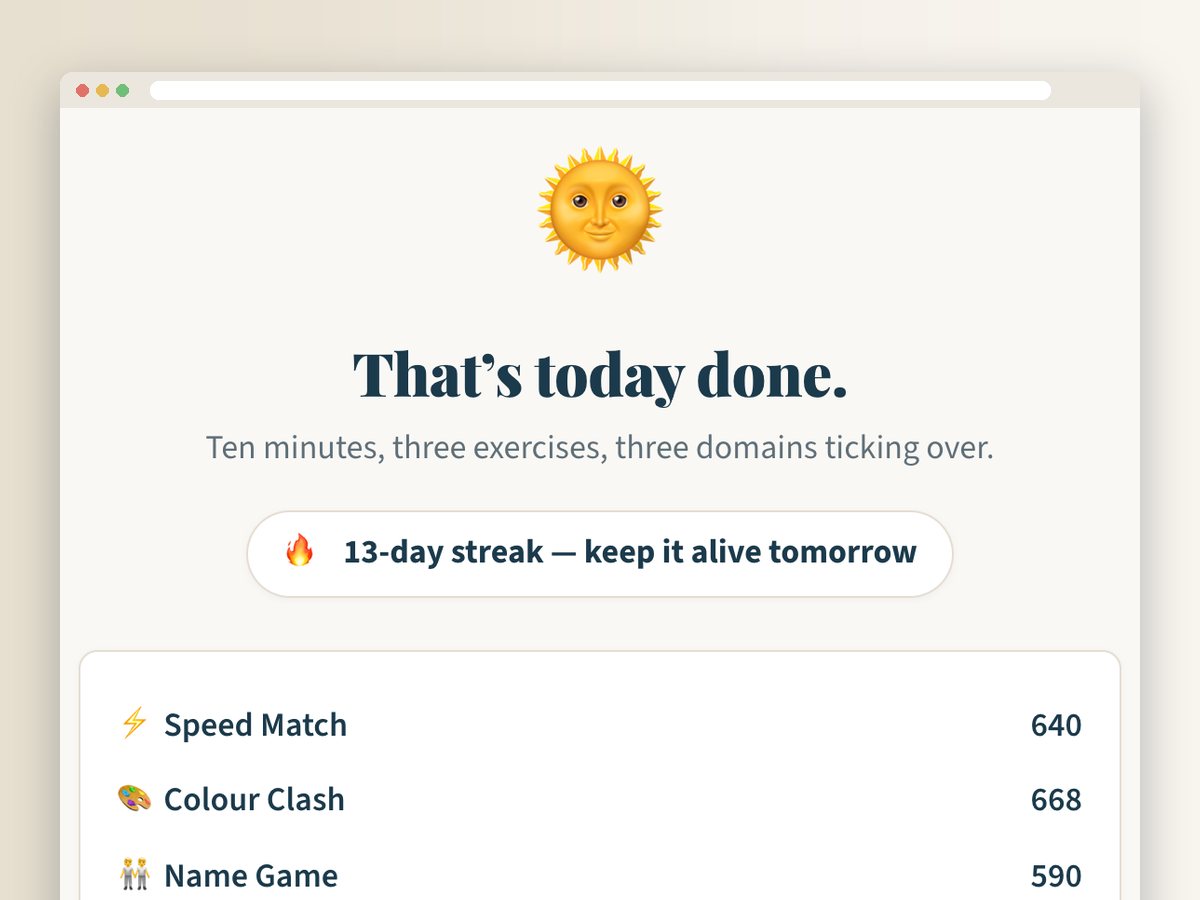
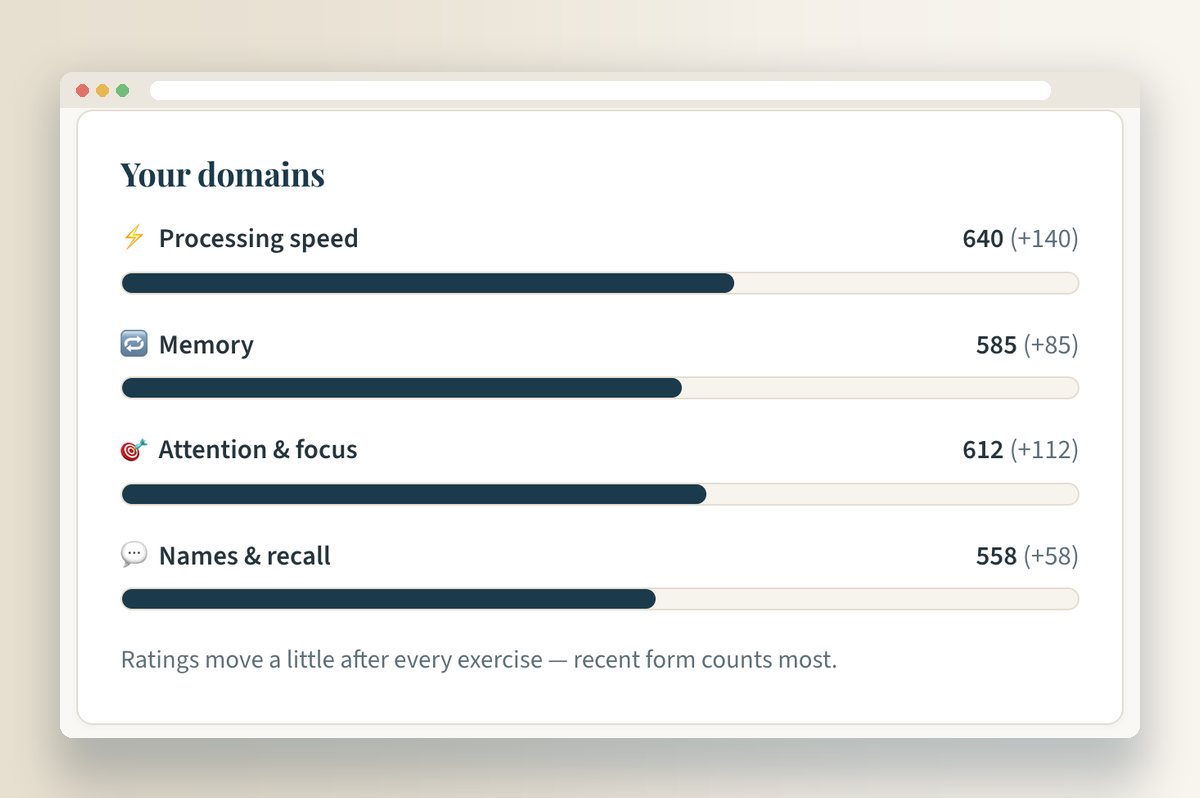
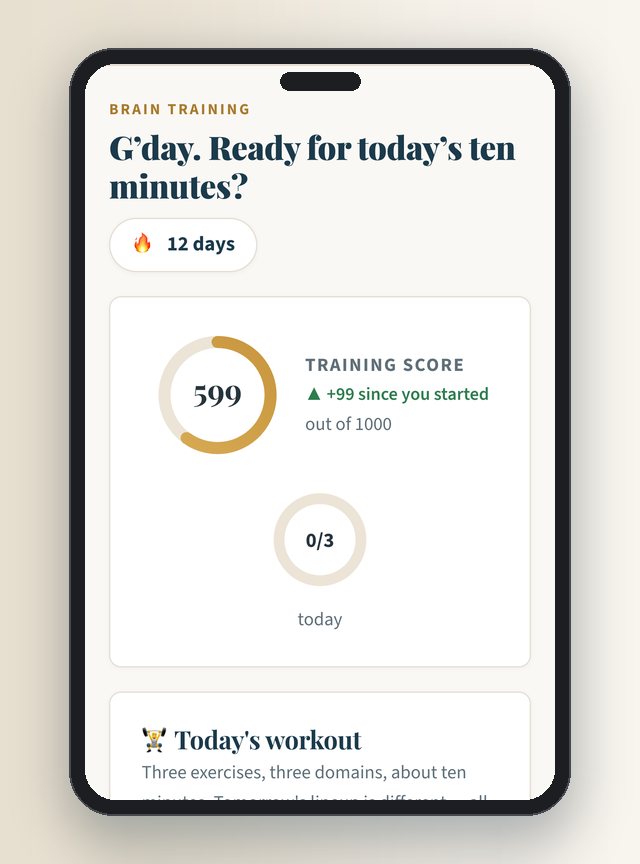
Real screens from the tool. The scores belong to an invented member on her thirteenth day.

Three exercises from the six each morning, about ten minutes all up. The lineup changes daily so every skill gets a turn across the week, and the day's card shows your best for each one.

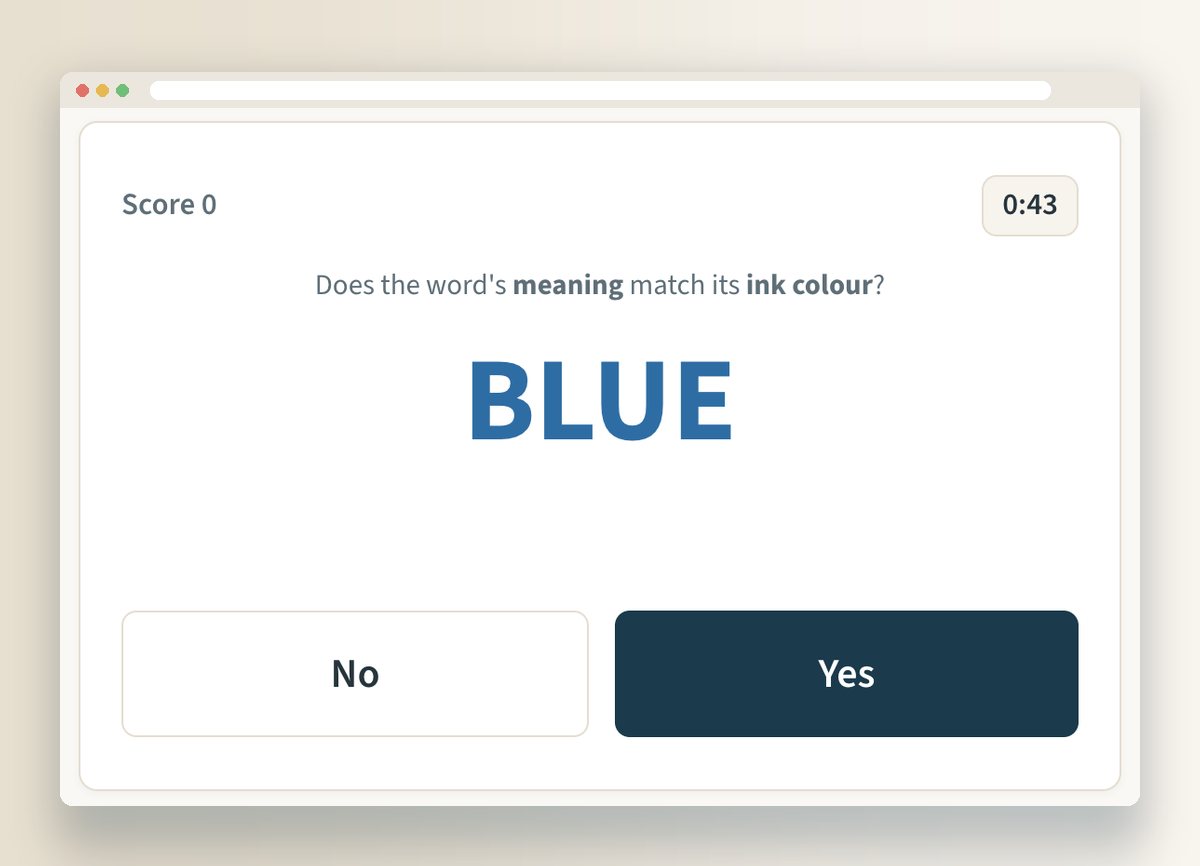
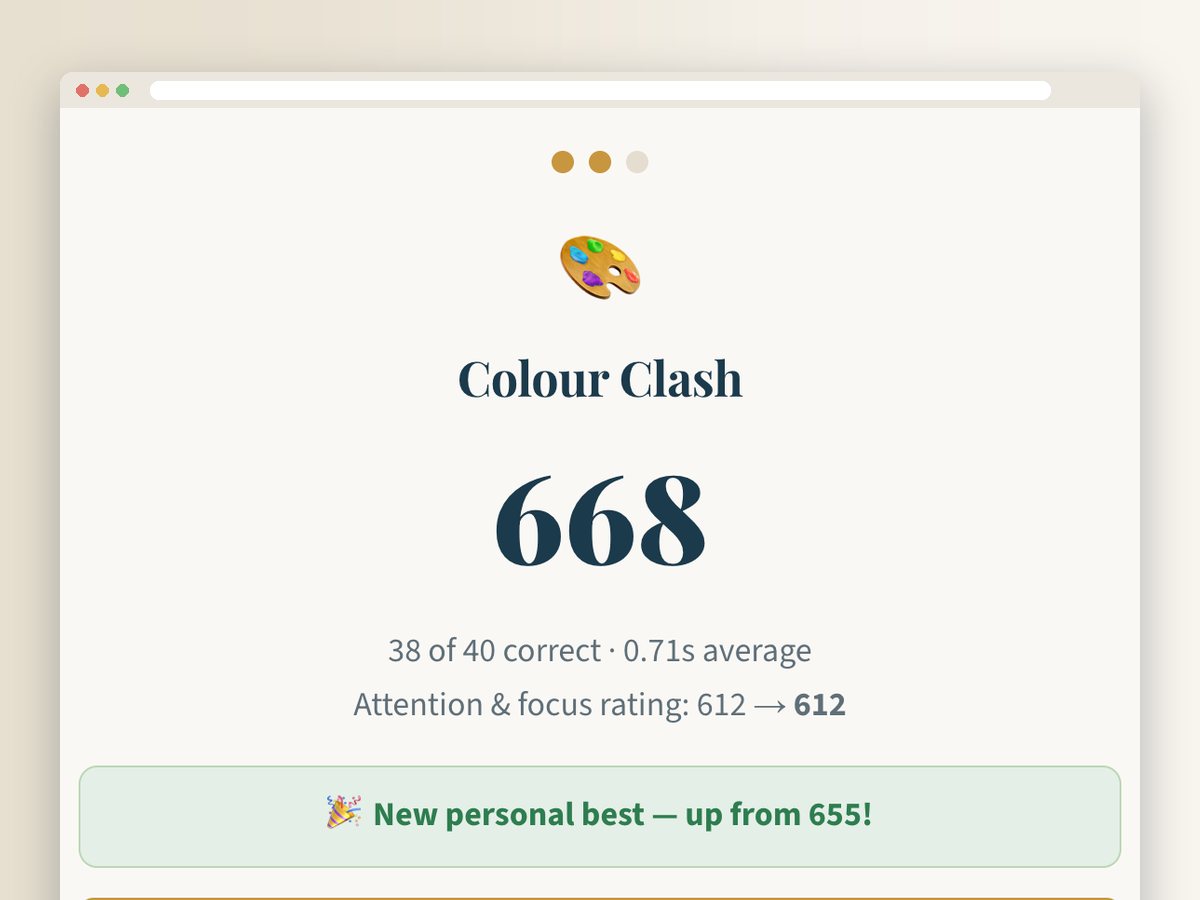
Colour Clash, shown here: the word says one colour, the ink says another, and you go with the ink. Each exercise is a couple of minutes with a visible timer and score, and nothing fiddly to tap.

Every exercise ends with a number, how it moved your rating for that domain, and whether you beat yourself. That's the only comparison there is — nobody else's score is anywhere on the page.

Finish the three and the day is done. The streak ticks over, tomorrow's exercises are named, and there's a line to copy if you want to tell a mate. Two Rest Day passes a month protect the streak when life gets in the way.

Processing speed, memory, attention and names — each with a rating that moves a little after every exercise, so you can see where you're quick and where you're rusty. The practice library sits underneath for whenever you want a particular one.

One column, large type, big buttons. The whole workout fits a phone screen, iPad or computer.
Three exercises picked from the six each morning, about ten minutes all up — a different mix every day so no one skill gets neglected.
Each exercise is a couple of minutes: quick decisions, a sequence to hold in mind, a colour that doesn't match its word, a face to put a name to. Big targets, clear type, nothing fiddly.
Streaks, personal bests, and a plain view of your four domains — where you're quick and where you're rusty. Badges for the milestones, if you like that sort of thing.
Nobody can promise brain games prevent dementia, and we don't. What's well established is that regular mental challenge is one of the good habits, alongside sleep, walking and seeing people. This makes the habit easy and enjoyable.
Large type, big targets, no ads, no 'upgrade to unlock' inside. The Name Game trains the thing people actually complain about — the name that's on the tip of the tongue.
The workout rotates through all six exercises so you're never grinding the same one. The full practice library is there whenever you want a particular one.
The daily trivia, Word Ladder, crossword and Word Wheel stay free for everyone, as they always have. Brain Training is the members' extra — the structured ten minutes.
Each exercise targets a different mental skill, so a week of workouts covers the lot.
Processing speed — quick yes-or-no decisions, faster each round.
Working memory — hold a growing sequence in mind and play it back.
Attention and focus — the word says one colour, the ink says another. Go with the ink.
Visual memory — find the matching pairs from memory, not luck.
Mental flexibility — connect the trail in order, switching between two sequences.
Names and recall — meet a face, then put the name to it a little later.
Daily Brain Training is one of the members' tools — alongside all 18 classes, both workbooks, the four mysteries and the other tools. Brain-training subscriptions charge $96 a year or more; membership is $79 a year for all of it — about $550 of value, for the whole household.
Already a member? Go straight to the tool →
The honest answer is that the evidence is mixed, and we make no medical claim. What's well supported is that staying mentally active, physically active and socially connected are all good for the brain as it ages. Brain Training makes the first of those an easy daily habit. Our class Your Brain After 60 walks through what the research actually says.
The four daily puzzles — trivia, Word Ladder, the mini crossword and Word Wheel — are free for everyone at morningpost.com.au/games. Brain Training is the members' extra: six structured exercises with scores and a streak, included in the $79-a-year membership alongside everything else.
Each exercise starts gently and gets a little quicker or longer as you improve, so it stays challenging without being discouraging. Your personal best is the only score that matters.
No. Streaks are there for the people who enjoy them; nothing scolds you for missing a day, and there's no notification nagging. Two Rest Day passes a month cover the odd miss automatically.
Yes — phone, iPad or computer, with large type and big targets throughout.