Free printable family tree templates
Four charts to print at home and fill in by hand: a 4-generation and a 5-generation pedigree chart numbered the way family-history societies do it, a family group sheet for the detail a chart can’t hold, and a three-generation “Our Family Tree” to do with the grandchildren. Below them, how to fill a chart in properly and where Australian records actually live.
The four templates
Each is a one-page PDF. Print at 100% (“actual size”), or take the 5-generation chart to a print shop for A3.
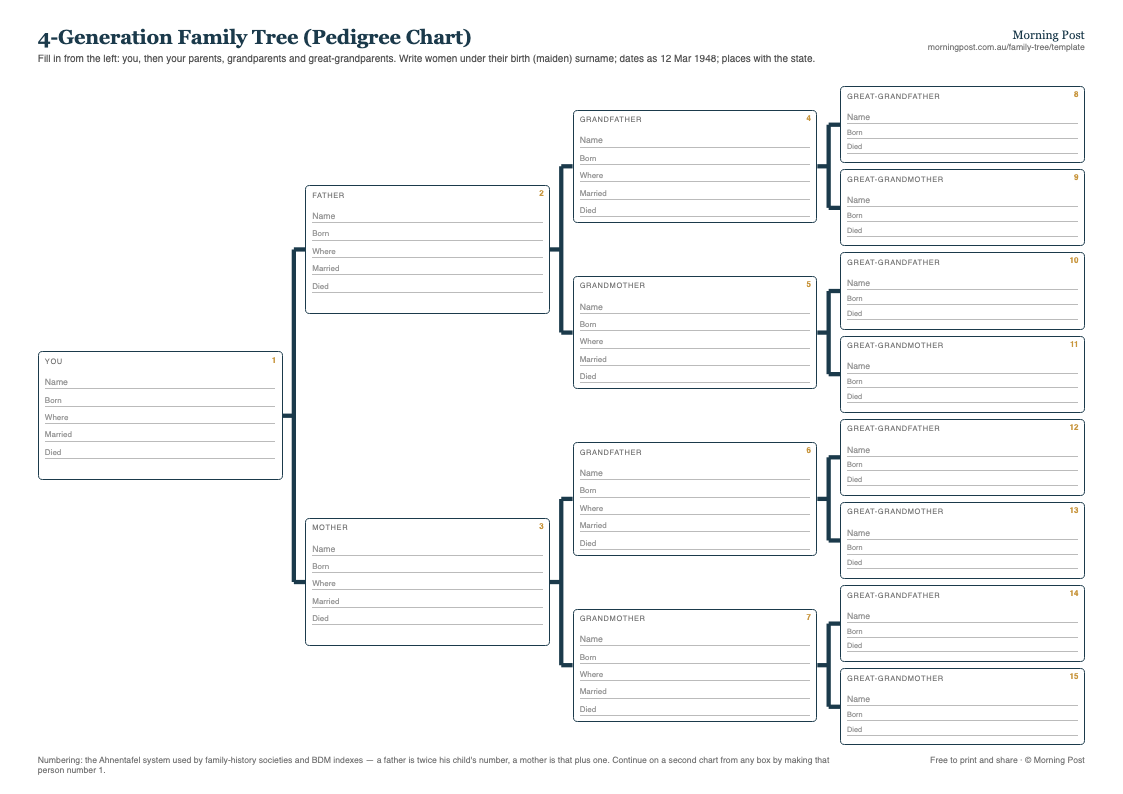
4-Generation Family Tree
You, your parents, four grandparents and eight great-grandparents: 15 boxes, each with name, born, where, married and died. As far as most people can get from memory and a few phone calls, and the chart to have beside you when you make those calls.
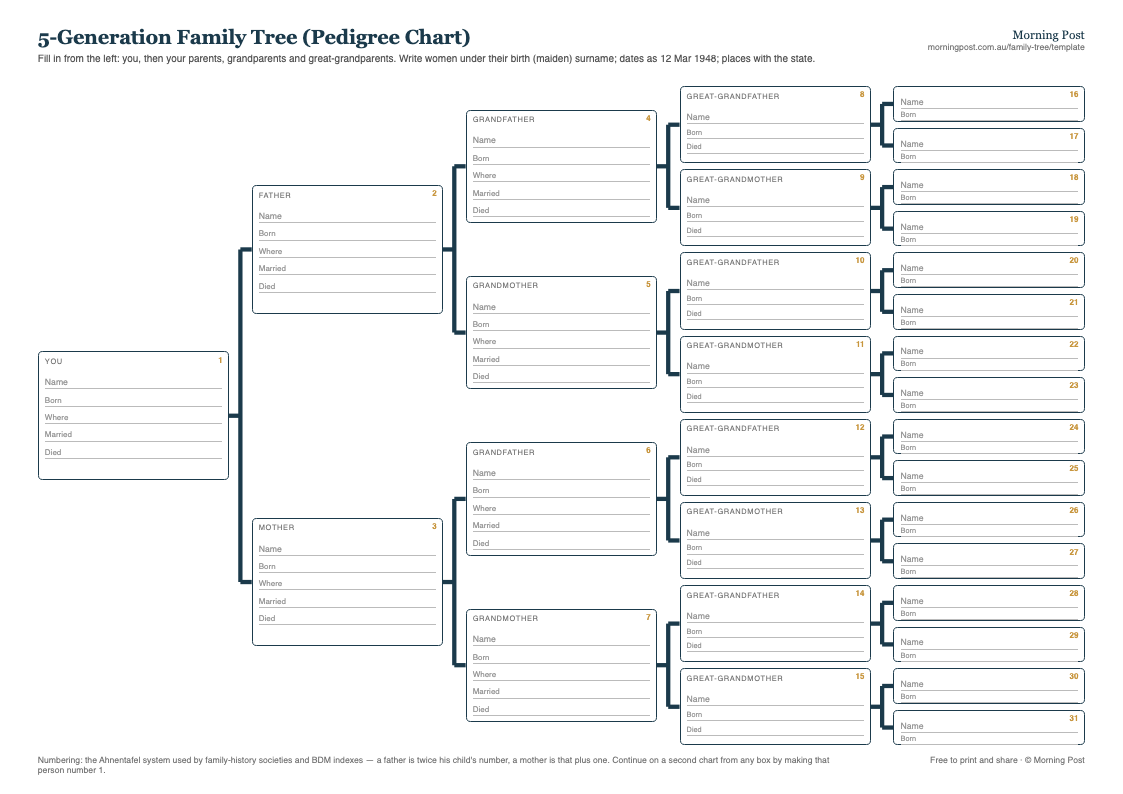
5-Generation Family Tree
Out to your sixteen great-great-grandparents: 31 boxes, with name and birth year on the outer column. Same numbering as the 4-generation chart, so you can carry names straight across. Prints well at A3.
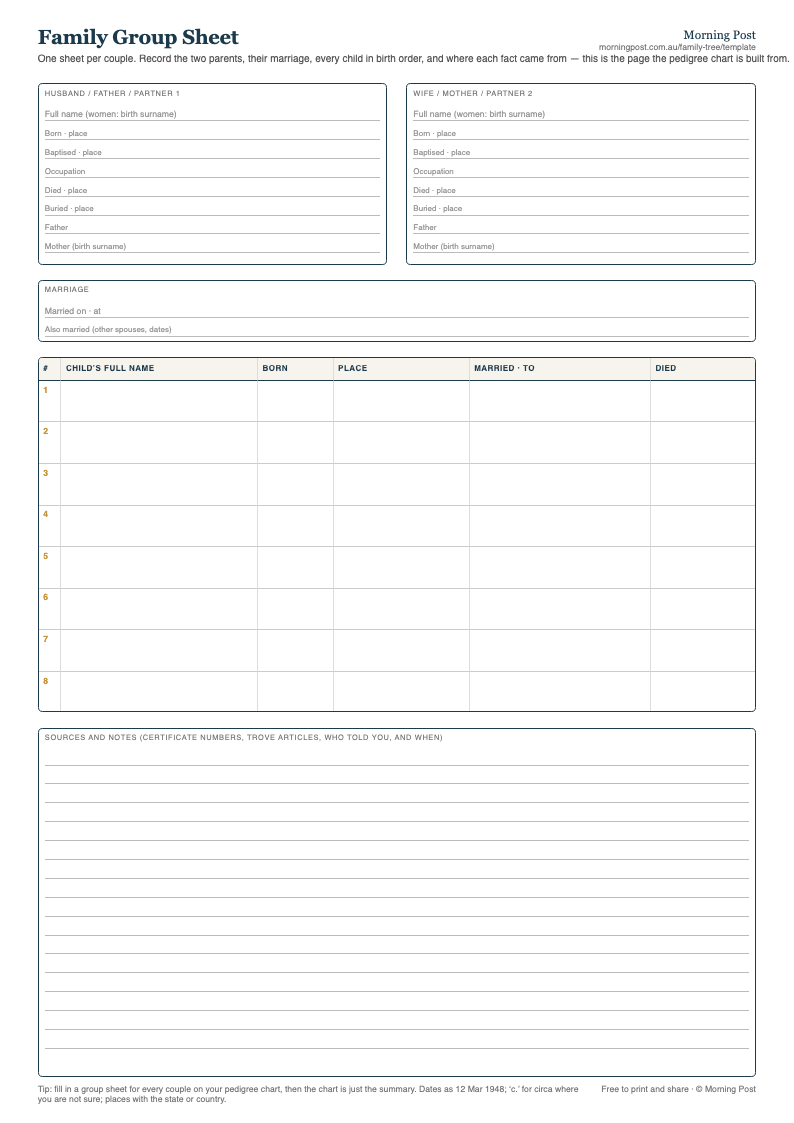
Family Group Sheet
The working page behind every chart: both parents with birth, baptism, occupation, death and burial, the marriage, every child in birth order with their own marriage and death, and a sources box for certificate numbers, Trove articles and who told you what. Fill one in for each couple on your pedigree chart.
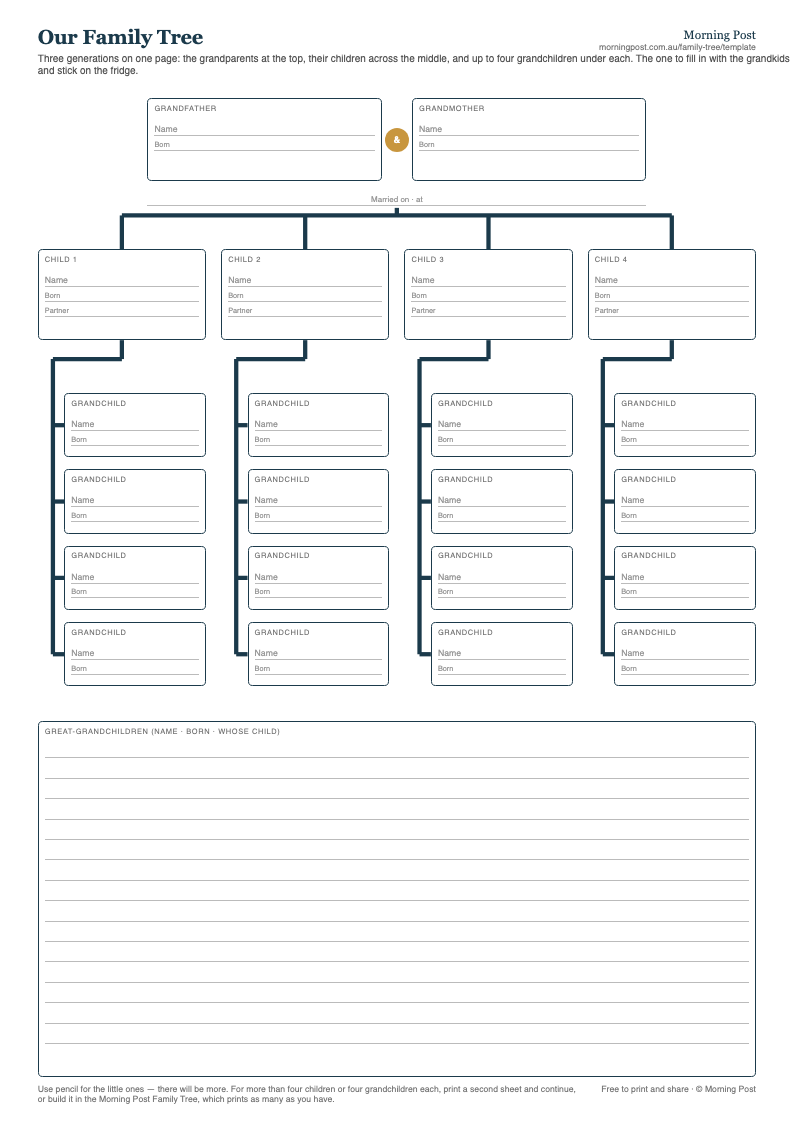
Our Family Tree (three generations)
Grandparents at the top, up to four children across the middle, four grandchildren under each and lines for the great-grandchildren. The one to fill in at the kitchen table with the grandkids, in pencil, because there will be more.
Would you rather type it?
The Morning Post Family Tree builds the same tree on screen: add people, partners and children, keep a photo and a story for each, and print a chart of the whole tree, however many generations you reach. It exports a GEDCOM file for Ancestry, FamilySearch or Family Echo, and it stays private to your household. One of the members’ tools, included in Morning Post membership: $79 a year.
How to fill in a family tree chart
- Start with yourself as number 1 and work left to right: parents, grandparents, great-grandparents. Write in pencil for anything you are not sure of.
- Follow the numbers. Your father is 2, your mother 3; a father is always twice his child’s number, a mother that plus one. The numbering (called Ahnentafel) is what family-history societies and BDM indexes use, so your chart will match the records you find.
- Women go under their birth surname. Put the married name in brackets if it helps, but the birth surname is the one the records are filed under.
- Dates as 12 Mar 1948, never 3/4/48. Use “c.” for circa, “bef.” and “aft.” where you only have a bracket, and leave a gap rather than guess.
- Places with the state or country, and the place as it was called then if it has changed.
- One family group sheet per couple holds what the chart can’t: baptisms, occupations, burials, every child, and where each fact came from. The chart is the summary; the group sheets are the record.
- Write down your sources as you go. “Nan said” is a source. So is a certificate number, a Trove article or a headstone photo. Six months from now you will want to know which was which.
- When a chart fills up, start a new one from any box: that person becomes number 1 on the new sheet, with their old number noted in the corner.
Where to find Australian records
Once memory and phone calls run out, these are the free starting points most Australian family historians use. Births, deaths and marriages are registered by each state, so start with the state your people were in.
Two habits save the most time: search Trove for a death notice before you order a certificate (the notice often names the whole family for free), and search the state BDM index for the marriage before the births, because a marriage entry usually gives you both parents’ names at once.
Questions people ask
Are these family tree templates free?
Yes. All four are free to download, print and share, with no sign-up. They are A4 PDFs that print on any home printer.
Which family tree template should I start with?
Start with the 4-generation pedigree chart: it is you, your parents, your four grandparents and your eight great-grandparents, which is as far as most people can get from memory and a few phone calls. Move to the 5-generation chart once you are into records, and use a family group sheet for each couple to hold the detail the chart cannot.
What do the numbers on the chart mean?
They are Ahnentafel numbers, the system every family-history society and BDM index uses. You are 1, your father is 2, your mother is 3, and from there a father is always twice his child’s number and a mother is that plus one. When a chart fills up, start a new one from any box by making that person number 1 and noting their old number.
Can I type into the templates?
These are print-and-write sheets by design. If you would rather type, the Morning Post Family Tree builds the tree on screen, keeps a photo and a story for each person, and prints a chart of your whole tree (as many generations as you have) or a GEDCOM file for other programs. It is part of Morning Post membership.
How should I write dates and names?
Dates as day, abbreviated month, four-digit year (12 Mar 1948) so 3/4 can never be misread. Write women under their birth surname, with the married name in brackets if it helps. Use ‘c.’ for circa where you are not sure, and write places with the state or country.
Can I print them larger than A4?
Yes. Any print shop can print the PDFs at A3 (choose ‘fit to page’ or 141%), which makes the 5-generation chart comfortable to write on.
Keep going
New to this? Read how to start your family tree in Australia, the step-by-step guide that goes with these charts. Morning Post also runs an eight-lesson class, Trace Your Family Tree, for members, and the free daily email for your city carries a local-history line most mornings. Pick your city: